Chris Bolton Fishing Barramundi
Chris Bolton uses single-hook handlines to harvest barramundi (Lates calacarifer) from Princess Charlotte Bay inside the Great Barrier Reef Marine Park, Queensland. His fishing operation for barramundi has met our Sustainable Australian Seafood Assessment Criteria for wild-catch seafood products.
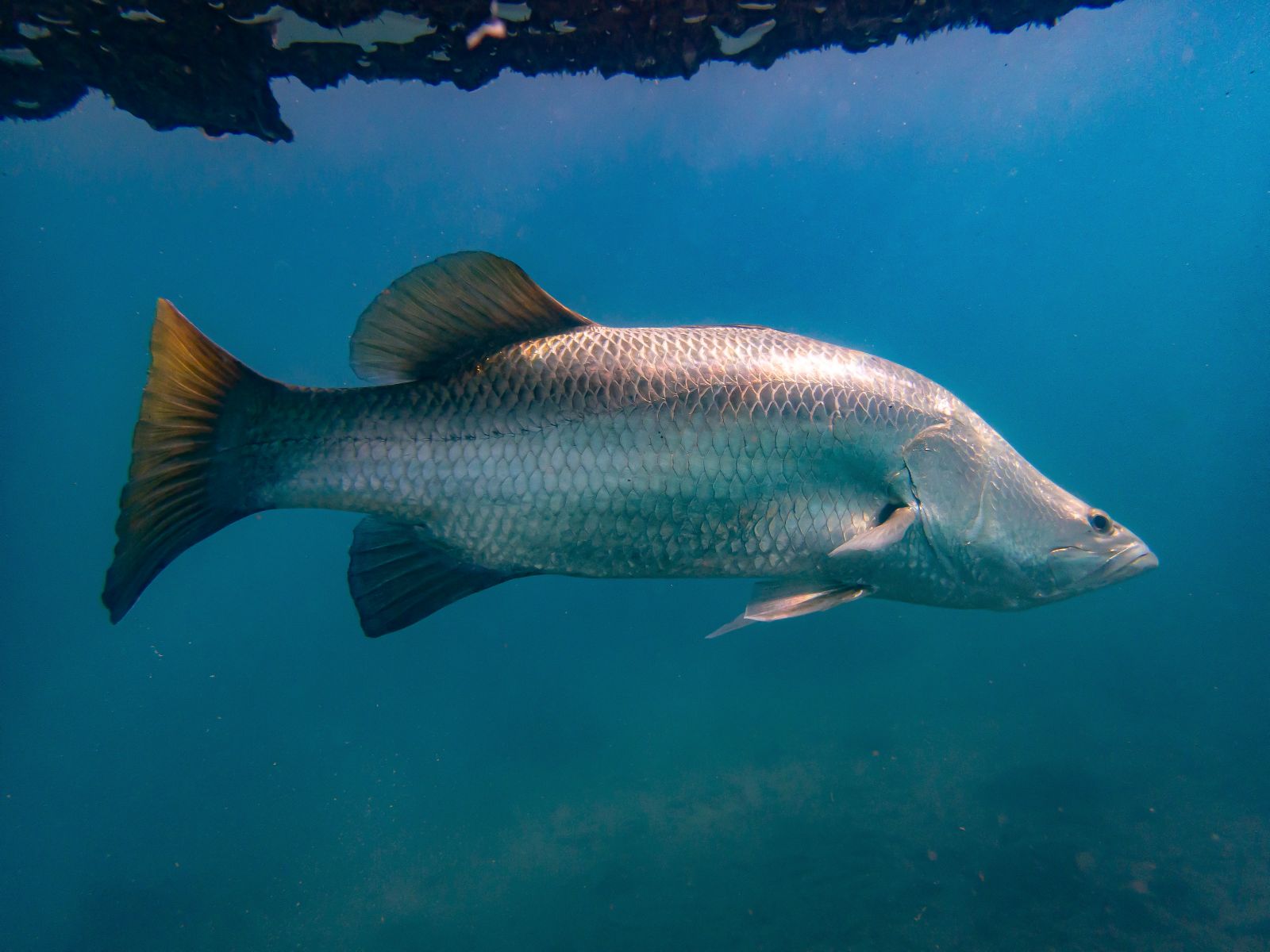
Barramundi (see photo by Lawrence Scheele) is a large, predatory fish species distributed across most of the Indo-West Pacific region, from the Arabian Gulf to China, Taiwan, Papua New Guinea and northern Australia. They are relatively long lived with some individuals reaching 20 to 35 years. They mature (mostly) as males first before changing into females, and they move between salt and freshwater habitats. The productivity of barramundi populations is closely linked to variation in rainfall, with wetter years linked to enhanced juvenile growth, recruitment, and subsequent greater fishery productivity.
Below are the overall and sub-criteria assessment summaries for Chris Bolton Fishing Barramundi.
Overall Assessment summary
| Criterion 1 Status of wild stocks: Target and by-product species | Wild populations at a healthy level and are managed to support the current rates of fishing over the long-term. |
| Criterion 2 Bycatch | Fish are captured using techniques that minimise the catch of other species, and released fish have high rates of survival. |
| Criterion 3 Impacts of fishing on habitats and ecosystems | Fishing causes minimal impact on the ecology of other ocean species and the health of their habitats. |
Assessment summary by sub-criteria
| Criterion 1: Status of wild stocks: Target and by-product species | |
|---|---|
| Management classification | Barramundi populations in Princess Charlotte Bay are regarded as underutilised because there has been no commercial net fishing in this region since 2020, and only limited take from commercial line fishing since 2024. |
| Current population relative to unfished level | There has not been a formal stock assessment in this region due to a lack of commercial fishing effort data in recent years, therefore the current population biomass level is unknown. However, it is estimated that current populations are likely close to virgin biomass i.e. a very high percentage of the pre-fished population level remains. |
| Extent of overfishing | Overfishing is not occurring, and the current level of fishing mortality is unlikely to cause significant stock declines. Other barramundi stocks along Queensland’s East Coast are managed to maintain biomass levels of 60% of unfished biomass. Princess Charlotte Bay currently has much lower fishing effort than other regions. |
| Long-term trends | The line fishery for barramundi in Princess Charlotte Bay has only been active for the 2024 and 2025 seasons. However, across Queensland, Barramundi stock levels and have shown positive long-term trends and sustainability in the fishery. |
| Biological parameters | The habitat range, age and size structure and the sex ratio of barramundi in Princess Charlotte Bay area are considered functionally normal and not significantly impacted by fishing. |
| Management effectiveness | The fishery is effectively managed by the Queensland Department of Primary Industries, in conjunction with the Great Barrier Reef Marine Park Authority. However, as this is a new fishery with limited licenses available there is a lack of independent monitoring and public reporting. |
| Criterion 2: Bycatch | |
| Is there bycatch? | Yes |
| Population impacts of bycatch | There is a lack of independent bycatch data and monitoring in this fishery, however highly selective fishing practices are implemented, and unwanted fish are released alive in good condition. The few retained byproduct species are also at healthy population levels. |
| Ecosystem impacts of bycatch discards | As the only discards reported by the fisher are a small proportion of undersized or oversized barramundi that are released alive, there would be no ecosystem impacts greater than minimal. |
| Management effectiveness | Due to concerns with bycatch of threatened, endangered and protected species (TEPS) in the previous gillnet fishery, management is phasing out gill nets in favour of other fishing methods such as line fishing. There is electronic reporting of catches and TEPS interactions in the line fishery, however data are not publicly available or independently verified. |
| Criterion 3: Impacts of fishing on habitats and ecosystems | |
| Trophic impacts of species catch (target and non-target species) | Studies have shown limited ecosystem and trophic impacts on the removal of barramundi from mangrove habitats. With limited catch quota and high fish biomass, trophic impacts are expected to be minimal. |
| Physical effects on habitats | Hook and line fishing is a minimal damage gear type for physical and biological impacts on habitats. Furthermore, biodegradable fishing line is used, so any lost line will not permanently stay in the environment. GPS guided electric outboards are used during fishing to allow the boat to stay on the spot instead of anchoring on sensitive habitats such as seagrass. |
| Spatial scale of impacts | The fishing operation focuses on a small proportion of the available fishable habitat in the Great Barrier Reef Marine Park (GBRMP), and adjacent rivers and estuaries where 33% of representative habitat is protected from fishing. Fishing is focussed in a small area within the larger East Coast Inshore Fishery Management Region 1. |
| Temporal scale of impacts | This fishery appears to have minimal impacts on habitats due to the line-fishing technique and the absence of anchoring on sensitive habitats. There would also be potential for rapid recovery from any minor impacts on habitats and ecosystems. |
| Management of impacts | Ecosystem impacts are constrained and well managed and monitored by various government agencies including the Queensland Department of Primary Industries and the Great Barrier Reef Marine Park Authority. The phasing out of gillnetting and the creation of no-fishing zones are examples of this. Voluntary agreements are embraced by Chris Bolton, such as being a Reef Guardian Fisher, to go beyond what is required by State and Federal laws. |