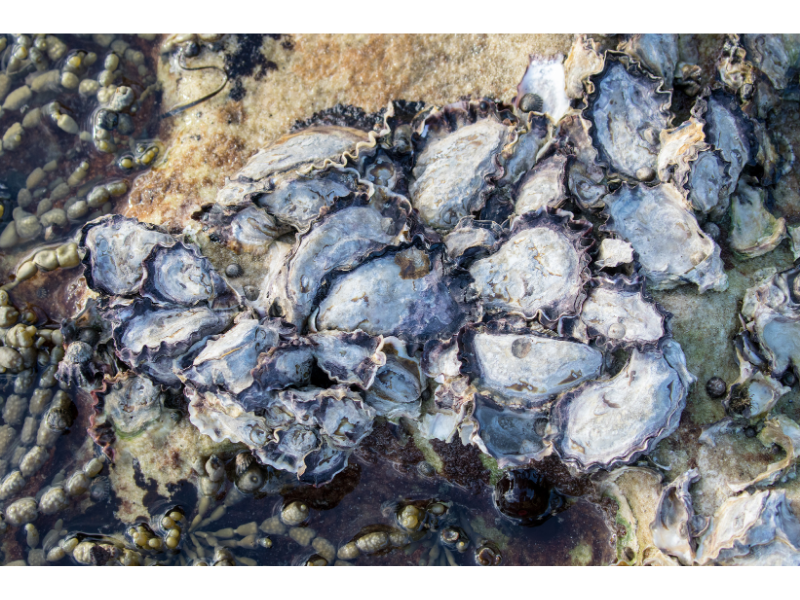
Merimbula Gourmet Oysters use floating bags to grow Sydney rock oysters (Saccostrea glomerata) in Merimbula Lake, New South Wales. The company’s seafood farming operation has met the Sustainability Australian Seafood Assessment Criteria for Farmed Seafood Products.
The Sydney rock oyster is a native Australian species found in sheltered estuaries and bays between Hervey Bay in Queensland and eastern Victoria. It has been farmed in New South Wales since the 1880s. They filter food from water passing over them and can tolerate a wide range of salinities and temperatures.
Sydney rock oysters are often regarded as the ‘lungs of healthy estuaries’ or the ‘canary of the estuary’, with scientists using them to monitor the health of estuaries. If the oysters are doing well, then the estuary should also be doing well.
Below are the overall and sub-criteria assessment summaries for Merimbula Gourmet Oysters.
| Criterion 1 Status of wild stocks: Target and by-product species | There is a low risk of harmful effects to native species through the spreading of disease or parasites. |
| Criterion 2 Bycatch | Operations do not adversely impact sensitive habitats or create cumulative impacts to the regional environment |
| Criterion 3 Impacts of fishing on habitats and ecosystems | There is a low risk of adverse effects in wild species populations or ecosystems from the farmed species interacting with the environment |
| Criterion 4 Sustainability of wild-sourced stock and food sources | Wild stocks of the farmed species spawn naturally and are not impacted by spat (larvae) collection for farming. Supplemental feed is not used. |
| Criterion 1: Disease and parasite risk | |
|---|---|
| Risk of spreading disease and parasites to native species | There is no evidence of disease or parasites from this facility impacting native species (although Sydney rock oysters can be susceptible to diseases introduced from other estuaries). |
| Input and use of chemicals | Chemicals are not used to produce Merimbula Gourmet Oysters. No antifouling is used on the infrastructure. Nor is chemically treated wood or tar used. The longline mesh bags that hold the farmed oysters are manufactured using UV-stabilised plastics. |
| Management effectiveness | The management agency, the NSW Department of Primary Industries and Regional Development (DPIRD), has in place effective biosecurity measures. Merimbula Gourmet Oysters meets all regulations and exhibits effective management of disease and parasites. However, there is a lack of publicly available evidence regarding regulatory compliance from the management agency. |
| Criterion 2: Siting and cumulative impacts | |
| Direct impact of infrastructure on habitats | The operation is in a seagrass dominated estuary, however the practice of using floating bags results in minimal effects on the habitats and ecosystems in Merimbula Lake. |
| Near-field impacts of water and sediment pollution | Chemicals are not used in the processing of oysters. Oysters filter feed naturally in the environment and remove particulate matter. This cycles nutrients to the seabed and increases water clarity, thereby encouraging seagrass growth. |
| Regional impacts | Floating-bag systems have minimal environmental impacts on seagrasses and no demonstrable impacts on sedimentation rates. Since replacing rack-and-rail infrastructure with floating bags, the impacts of shading on seagrass have been greatly reduced and seagrass coverage has been increasing. |
| Management effectiveness | The regional planning, research, monitoring and compliance within the oyster industry is effectively managed by NSW DPIRD. Merimbula Lake Oyster Growers produced an Environmental Management System (EMS) in 2011 to help guide environmental best practices, and an updated EMS is planned in the future. |
| Criterion 3: Wildlife interactions | |
| Insignificant risk of wildlife interaction | There is no evidence to suggest that the operation’s risk to wildlife is insignificant (continue to the following sub criterion). |
| Behavioural effects | Both fish and bird species interact with oyster leases for feeding and refuge opportunities, but this does not result in significant negative impacts to those species. |
| Entanglements and incidental mortality | There have been no reported entanglements of wildlife in the longlines that suspend the floating bags. Hollow, large-diameter poles that could trap birds were they to perch and fall inside, are not permitted. |
| Escapes, translocations and genetic impacts | As Sydney rock oysters are a native species in this estuary there are no issues regarding escapement. Broadcast spawning of farmed oysters is regarded as beneficial to the wild populations. Although a small proportion of selectively bred, disease-resistant spat is introduced to the estuary, there is no evidence of any genetic impacts on the wild populations. |
| Management effectiveness | As there does not appear to be any significant wildlife interactions, there are also limited management regulations by the management agency and no publicly available evidence regarding compliance. |
| Criterion 4: Sustainability of wild-sourced stock and food sources | |
| Ongoing reliance on wild stocks for broodstock, juveniles or feed | There is ongoing reliance on wild populations for juvenile oysters (continue to the following sub criterion). |
| Wild stocks are sustainable | The majority of the source stock is collected from the wild, primarily in the neighbouring estuary of Pambula Lake. It is unlikely that the intensity of spat collection from Pambula Lake results in the depletion of wild stock. |
| Food is from sustainable sources | Supplemental feed is not used, and the scale of farming does not limit the natural food available to wild populations. |